
What I Do!

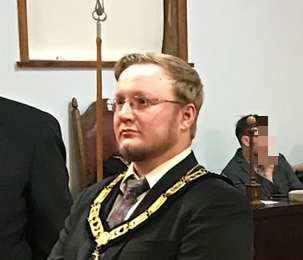
Arbon C. Ransom was raised to the sublime degree in the latter part of 2019. A lover of the great philosophers, a voracious reader, and as an absolute scholar of the arts and sciences, AC loves to spend his time expounding his thoughts into well written essays and beautifully crafted music and lyrics. On occasion he can be found sinking hooks into the local steams of Utah in both warm and not so warm weather hunting for that elusive monster fish that seems to always snub his lures.

Jason Lee currently sits as one of Harmony Lodge's Trustees. A man of sound mind and a clean conscience, he wishes to keep his full identity secret so as to not drive all the single ladies insane with even a glimpse of his celestial magnificence.

Gary T. Roberts is the current Secretary of Harmony Lodge No. 21 in Logan, Ut. Gary is a 32° Master of the Royal Secret of the Scottish Rite and is a member of the Valley of Salt Lake City in the Orient of Utah. He is also a Sir Knight in the York Rite and serves in the Grand York Rite Bodies of Utah as a member of Ogden Chapter No. 2, Ogden Council No. 3, and El Monte Commandery No. 2. He cherishes the Brothers and friendships he has made since becoming a mason. He is thankful for the opportunities Freemasonry gives and has given him to examine and improve himself, to meet people he might not otherwise have had chance to meet, and to do things he might not otherwise have had a chance to do. He is employed as a manager over global product test and compliance at Campbell Scientific, Inc. and lives near Logan, UT with his wife Marci and their three children. He looks forward to sharing the joy the fraternity brings him with others. He holds a degree in Fire Science, from Utah Valley University, with honors and retired as Fire Chief in 2011. He currently works as volunteer EMS Chief for his community. He enjoys his membership in the BSA and Order of the Arrow (Vigil Honor). His email address is gtroberts@protonmail.com.
A Brother’s reflection, written in recovery

There is a sentence that arrives in the world once every fifteen seconds. Somewhere a clock ticks it out, and a stranger I will never meet hears the same five words I heard at the end of February: I’m sorry — you have cancer. I have spent a working life around emergencies, kneeling on cold pavement with a hand on someone’s chest, and I thought I understood how a life turns on a single moment. I did not. There is a particular silence that opens up when the words are spoken to you, when the patient on the cot is the man you shave every morning. The room does not change. The light through the window is the same. Everything is the same except that you are now standing on the far side of a door that has quietly closed behind you.
In some jurisdictions there is a small room a candidate is made to sit in before he is received — the Chamber of Reflection. A skull. An hourglass with the sand already running. Bread and water. The single instruction set before him: Know thyself. He is asked to consider his own mortality, to descend into the dark before he is permitted to rise. I have never sat in such a room, but I have read of it and thought about it often, and I always believed I understood what it was for. I thought I had done that work some other way, in my own quiet hours. February taught me the difference between a lesson studied and a lesson lived. No amount of contemplation, in any room, prepares a man for the hourglass when it is his own sand running out.
In April the surgeons took the left upper lobe of my lung. I came home to a house run by a nurse who happens to also be my wife, and I have healed — slowly, with mild pain and a drain I learned not to look at, but I have healed. The reports are good. By every reasonable measure I am going to live.
And that is the part I cannot write about cleanly, because it is the part that has no clean shape.
I am going to live, and they did not.
Two of my own fire staff went into the ground because of this same enemy. We carry one another’s gear, we sit in the same trucks, we breathe the same air at the same scenes, and the slow arithmetic of that service settled its bill with them and not, so far, with me. And just lately a good friend — a peace officer, a man who stood watch over this valley the way I tried to — was taken by the very cancer that came hunting me, the lung, and he is gone and I am here typing this with both feet on the floor.
I do not know how to forgive myself for that. I want to say it plainly, the way I’d write it in a run report, because softening it would be a lie. There is no version of this where I get to feel grateful for my life without also feeling the cold injustice of it. Why is the one who deserved no more than they did the one who walks out of the building? I have turned that question over for weeks and it does not wear smooth. It stays sharp.
But I have learned something in the turning, and the Craft is what taught it to me, so let me set it down here.
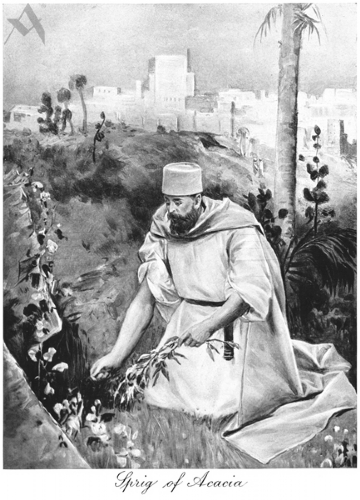
When we lower a Brother into the earth we cast a sprig of acacia upon the casket. The acacia is an evergreen. It is the oldest thing we say without saying it: that something does not die when the body does, that there is a part of a man the grave does not get to keep. We are taught that the soul is that house not made with hands, eternal in the heavens. I have stood at gravesides and recited those words over men I loved. I believed them on their behalf. I am only now being made to believe them on my own.
And there is the Level. Of all our working tools it is the one I keep returning to in the dark. We are taught that we meet upon the Level and part upon the Square — that whatever a man’s station, the grave receives us all as equals, that the prince and the laborer lie down in the same dust. I used to hear that as a lesson about humility. I hear it differently now. The Level does not only mean we are equal in death. It means I am not standing on higher ground than the men who went before me. We are on the Level still — they have only gone ahead to a labor I have not yet been called to. My living is not a verdict that I was worth more. The Level forbids that reading. It was not a contest, and I did not win it, and they did not lose.
So what is left for the one who lives?
The guilt, I have decided, is not a sin to be confessed away. It is the shape love takes when it has nowhere left to go — when the man you would have carried out of the fire is past carrying, and all that strength has no door to walk through. You feel it as guilt because it cannot reach them. But it can still reach the work.
In Lodge there are empty chairs now. I am the Secretary; I am the one who keeps the rolls, who writes down who was present and who was not, who records the passing of a Brother in the minutes in plain ink. It falls to me, of all men, to be the keeper of the names. I have decided that this is not a clerical accident. The dead asked nothing of me except to be remembered and to have their labor continued. They did not ask me to stop living in their honor. No firefighter ever wanted his brother to lay down his tools at the grave. The whole of our oath is the opposite — that the work goes on, that the rough ashlar keeps getting cut, that someone keeps the temple rising after the builder falls.
So I will take up the working tools again, with one lung and a debt I can never repay and have decided instead to pay forward. I will sit in the South, East, and the West for men who can no longer sit anywhere. I will write their names in clean ink. And when at last my own sand runs out — later now than I feared, but it will run — I hope a younger Brother casts a sprig of acacia for me and means it, the way I have meant it, every time.
I heard the words a stranger hears every fifteen seconds. I am still here to write the next sentence. That is not a thing to be forgiven. It is a thing to be answered.
So mote it be.
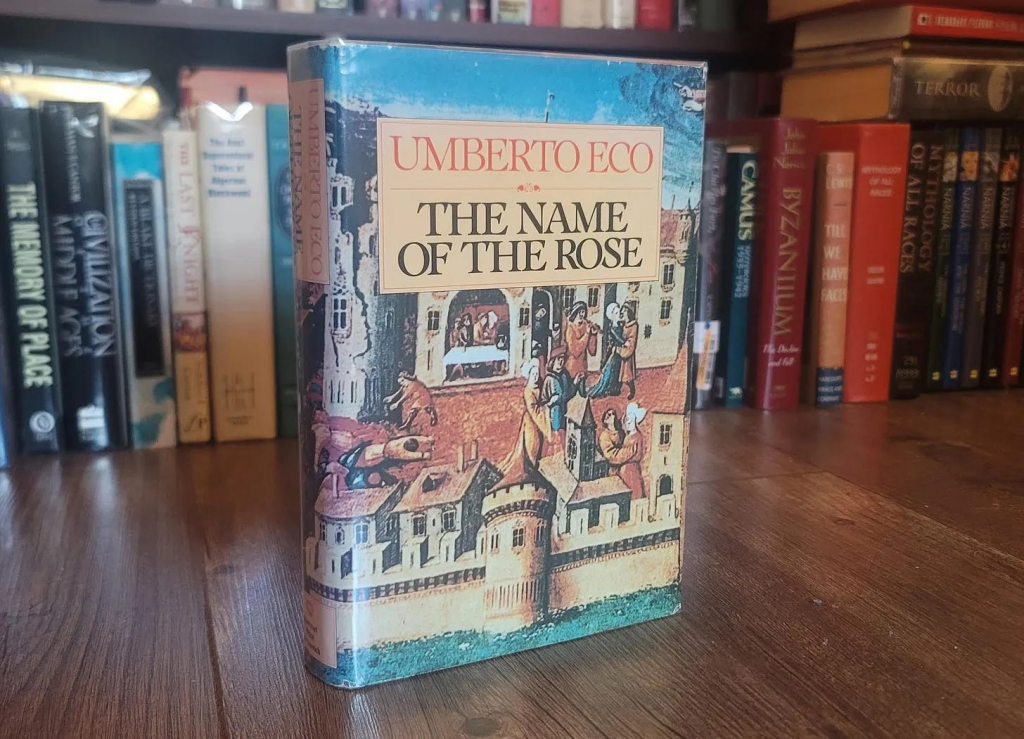
Umberto Eco’s masterwork, The Name of the Rose, published in 1980, stands as one of the most intellectually rich novels of the twentieth century. Set in a Benedictine monastery in Northern Italy during November 1327, this historical murder mystery follows the Franciscan friar William of Baskerville and his novice Adso of Melk as they investigate a series of mysterious deaths connected to the monastery’s legendary library. While ostensibly a medieval detective story, Eco’s novel explores profound themes that resonate deeply with Masonic philosophy: the pursuit of knowledge, the danger of dogmatic certainty, the importance of reason and free inquiry, and the proper relationship between tradition and progress.
As Freemasons, we recognize our Craft as a progressive science, one that encourages the pursuit of truth through the application of reason and the cultivation of virtue. The parallels between William’s investigation in the labyrinthine library and our own Masonic journey toward Light are striking and instructive. This essay examines how the lessons embedded in Eco’s narrative can inform and enrich our understanding of Freemasonry’s purpose and principles.
At the heart of The Name of the Rose lies a magnificent library, carefully guarded and deliberately obscured. The library’s design is itself a labyrinth, meant to confuse and disorient those who would seek its treasures without authorization. Only the head librarian possesses complete knowledge of its structure and contents. As the investigation unfolds, William discovers that the murders are connected to a forbidden book—Aristotle’s lost second volume of Poetics, which treats the subject of comedy and laughter.
The villain of the piece, the elderly blind monk Jorge of Burgos, has poisoned the pages of this book, killing those who would read it. His motivation stems from a rigid orthodoxy: he believes laughter undermines fear of God, that certain knowledge is dangerous, and that some truths must be kept from the many for their own protection. Jorge represents the impulse toward intellectual tyranny, the belief that some minds are fit to judge what others may know.
For Freemasons, this theme resonates profoundly. From our first degree, we are taught that Freemasonry offers Light—not in the sense of mystical revelation, but as the illumination of knowledge, reason, and truth. The Entered Apprentice emerges from darkness into light, beginning a journey of moral and intellectual improvement. Like William navigating the library’s maze, we advance through our degrees, each revelation building upon the last, each symbol pointing toward deeper understanding.
The monastery’s hidden library serves as a powerful metaphor for the human condition before enlightenment. Jorge’s poisoning of knowledge represents the anti-Masonic impulse: the fear of free inquiry, the impulse to restrict access to truth, the belief that knowledge is too dangerous for ordinary minds. Against this, William—and by extension, Freemasonry—argues for the democratization of learning, the application of reason, and trust in humanity’s capacity to handle truth responsibly.
Perhaps the most chilling aspect of Jorge’s character is his absolute certainty. He knows, without doubt, that laughter is sinful, that Aristotle’s book must be destroyed, that his murders serve a higher purpose. He operates from an inflexible system of thought that admits no questioning, no nuance, no possibility of being wrong. His certainty makes him monstrous.
William of Baskerville, by contrast, embodies intellectual humility. Though brilliant and learned, he acknowledges the limits of his knowledge. He forms hypotheses but remains willing to revise them as new evidence emerges. He seeks truth not to possess it as a weapon, but to understand the world more fully. Even at the story’s conclusion, when he has solved the mystery, he reflects on how many of his interim theories were incorrect, how often he was led astray by his own assumptions.
This tension between dogmatic certainty and humble inquiry speaks directly to Masonic principles. Freemasonry is not a religion, makes no claim to exclusive truth, and welcomes men of all faiths. We require only a belief in a Supreme Being, leaving each Brother free to understand the nature of the Divine according to his own conscience and tradition. This tolerance stems from epistemic humility—the recognition that ultimate truth may be approached from many paths, that no man possesses a monopoly on wisdom.
The Masonic ritual repeatedly emphasizes this theme. We are told to square our actions by the Square of Virtue, to circumscribe our desires and keep our passions within due bounds. This applies not merely to physical appetites but to intellectual pride. The Mason who believes he has nothing left to learn, who approaches the Craft with rigid preconceptions, who cannot entertain perspectives different from his own—such a Mason has ceased his true Masonic journey, just as Jorge ceased to be a true seeker of wisdom.
Our ritual also teaches that we should be “free from the dominion of unruly passions” and to practice “Tolerance and Brotherly Love.” The dogmatic mindset—whether religious, political, or philosophical—violates these principles. Jorge’s murders stem from his inability to tolerate views different from his own, his unwillingness to grant others the freedom to read, think, and laugh. For Freemasons, who sit in lodge alongside Brothers of diverse backgrounds and beliefs, this serves as a cautionary tale.
Ironically, Jorge is the monastery’s librarian, charged with preserving knowledge for future generations. Yet his fear and dogmatism lead him to destroy the very treasures he should protect. At the novel’s climax, he eats the poisoned pages of Aristotle’s work and sets fire to the library, choosing destruction over the possibility that forbidden knowledge might spread. The monastery burns, and centuries of accumulated wisdom are lost to flames.
This catastrophe reflects a perennial tension: the relationship between tradition and change, between preservation and progress. Jorge sees himself as defending tradition, but he has confused tradition with stagnation. He preserves the forms while killing the spirit. His library contains treasures but forbids access to them. His supposed guardianship becomes tyranny.
Freemasonry understands this balance differently. We are indeed an ancient institution, proud of our traditions and protective of our modes of recognition. We preserve our ritual with care, passing it from memory through living chains of Brothers. We honor the Landmarks, those fundamental principles that define what Freemasonry is and is not. Yet we also recognize that the Craft must speak to each new generation, that its principles must be applied to contemporary challenges, that living tradition requires both continuity and adaptation.
The Mason is both guardian and herald—we preserve the ancient wisdom while remaining engaged with the present world. Our lodges are neither museums nor revolutionary cells, but rather communities where timeless principles illuminate modern lives. We do not burn our libraries or poison our teachings with fear. Instead, we open our doors to worthy candidates, confident that Masonic light can guide men through changing times.
The tragedy of Eco’s library resonates with any Mason who has seen a lodge fail through insularity, who has watched membership decline because Brothers chose preservation over vitality, who has witnessed the Craft become irrelevant through refusal to engage meaningfully with the concerns of potential members. Jorge’s error is not his love of tradition but his fear of life. He chooses death over risk, sterility over the messiness of human engagement.
William of Baskerville approaches the murders as a detective, employing careful observation, logical deduction, and systematic investigation. Eco modeled William partly on Sherlock Holmes (the name “Baskerville” is a clear reference) and partly on the medieval philosopher William of Ockham, known for his principle that simpler explanations are preferable to complex ones. Throughout the novel, William demonstrates the power of rational inquiry guided by moral purpose.
His method stands in sharp contrast to the monastery’s inquisitor, Bernardo Gui, who arrives to investigate heresy. Gui operates from predetermined conclusions, seeing heresy everywhere, extracting confessions through torture, and sending innocent people to their deaths. He represents the corruption of investigation—the use of interrogation not to discover truth but to confirm prejudice and consolidate power.
For Freemasons, this distinction is crucial. Our Craft teaches us to seek truth through the proper application of our intellectual faculties—reason, judgment, and discrimination. The Working Tools of the Entered Apprentice include the Twenty-Four Inch Gauge and the Common Gavel, instruments for dividing our time wisely and removing the rough edges of our character through discipline and self-examination. These represent the systematic approach to self-improvement that parallels William’s systematic approach to investigation.
The investigation of truth requires virtue as well as intelligence. William succeeds not merely because he is clever but because he is good. He shows compassion to the weak, justice in his judgments, and courage in confronting power. He seeks truth not for personal glory but because lives depend upon it and because knowledge has intrinsic value. His novice Adso learns from him that the pursuit of wisdom cannot be separated from the practice of virtue.
This union of intellectual and moral development defines the Masonic enterprise. We are not merely a philosophical society studying ethics in the abstract, nor are we simply a charitable organization acting without deeper principle. Rather, we integrate thought and action, knowledge and virtue, contemplation and engagement. The good Mason, like William, brings his whole self to the work—mind and heart, reason and compassion.
Throughout the novel, knowledge is power, and the restriction of knowledge is a tool of control. The library’s labyrinthine design, the secret catalog known only to the librarian, the forbidden sections—all exist to maintain hierarchies of access. Jorge and his predecessors have positioned themselves as gatekeepers, determining who may know what, which books are safe for general reading and which must be restricted.
This system corrupts those who control it. What begins as prudent stewardship becomes tyranny. The librarians see themselves as protecting others but grow to despise those they protect. Jorge comes to hate laughter itself because common people laugh; he sees joy as lowly, wisdom as the province of an elite few. His secret knowledge isolates him, making him bitter, cruel, and ultimately murderous.
Freemasonry operates under a paradox here. We do have secrets—our modes of recognition, certain portions of our ritual, the private nature of our lodge meetings. Yet our essential teachings are available to anyone: our values are proclaimed publicly, our charitable works are visible, our principles are written in countless books. As we often say, Freemasonry is a secret society with a website.
The key difference lies in purpose. Our secrecy exists not to concentrate power but to create sacred space, to establish bonds of trust, to preserve the solemnity of our ritual, and to ensure that candidates experience our degrees with the full impact of their symbolism undiminished. We restrict access not to knowledge itself but to the experience of initiation, which cannot be communicated secondhand but must be lived.
Moreover, Masonic secrecy is temporary and partial. What is hidden from the profane world is revealed to the initiate. What seems mysterious before the degree becomes clear after. And crucially, no Mason is forbidden to advance—every Entered Apprentice can become a Fellow Craft and then a Master Mason, every Master Mason can seek the additional degrees if he wishes. Our system is one of progressive revelation, not permanent exclusion.
Jorge’s library offers no such promise. Some books remain forever forbidden, some monks will never gain access, knowledge stays concentrated in the hands of the few. This is anti-Masonic in spirit. We might say that Jorge has created a profane system of secrets, while Freemasonry maintains a sacred system of mysteries—mysteries that invite rather than exclude, that illuminate rather than conceal.
One of the novel’s most profound themes concerns Jorge’s hatred of laughter. He views comedy as subversive, as undermining respect for authority and doctrine. The book he destroys—Aristotle’s treatment of comedy—argues that laughter is natural to humanity, that comedy serves social and intellectual purposes, that joy is not inherently sinful. Jorge cannot tolerate this idea because his entire worldview depends on fear, gravity, and the suppression of human spontaneity.
William counters that laughter can be a tool of liberation, helping people see through pretension and question authority. He suggests that perhaps God laughs at creation’s diversity, delights in human cleverness, and wants us to experience joy. The prohibition of laughter, he implies, is really about maintaining control—people who laugh are harder to dominate.
This resonates with Masonic fellowship. While our ritual is solemn and our purposes serious, Masonic culture has always included fraternal joy. We gather for festive boards, tell stories, share laughter, and enjoy one another’s company. This is not incidental to our Craft but essential to it. Brotherhood flourishes in joy as well as in solemnity. The lodge that has lost its capacity for laughter has lost something vital.
More deeply, laughter represents an intellectual flexibility, a willingness to see things from unexpected angles, a refusal to take ourselves too seriously. The Mason who can laugh at himself, who can enjoy the absurdities of human nature while striving to improve, who can find delight in the journey even when progress is slow—such a Mason embodies Masonic wisdom more fully than the Brother who approaches everything with grim determination.
Jorge’s murders stem from his inability to tolerate joy. His monastery, for all its supposed piety, becomes a place of fear, suspicion, and death. The lesson for Freemasonry is clear: a lodge that privileges severity over brotherhood, that emphasizes restriction over welcome, that sees solemnity as synonymous with grimness—such a lodge may preserve forms while losing spirit. Our ancient charges speak of meeting “on the level” with “mirth and good humor”—not as a concession to human weakness but as recognition of human wholeness.
The Name of the Rose ends in destruction: the library burns, the manuscript is lost, the monastery is devastated. Yet knowledge survives through transmission—William and Adso carry away what wisdom they can, memories preserved in minds if not on pages. Adso, now old, narrates the story decades later, ensuring that its lessons endure. From the ashes of one library, countless readers have drawn insight.
This ending teaches resilience and responsibility. Knowledge lives not in buildings or books alone but in people who carry it forward. Tradition persists not through rigid preservation but through living transmission. Each generation receives the torch and must bear it faithfully while adapting to new challenges.
For Freemasons, this is deeply familiar. We preserve our ritual through memorization, Brother teaching Brother across generations. Our lodges exist not primarily as buildings but as communities of men committed to shared values. When a lodge goes dark, if even one Brother maintains the teachings, the possibility of rekindling remains. We are, each of us, both recipients and transmitters of Masonic light.
The lessons of Eco’s masterpiece for the modern Freemason are manifold:
• Pursue truth with humility, recognizing that our understanding is always incomplete and our certainties may be mistaken.
• Guard against dogmatism, whether in religion, politics, or philosophy, for absolute certainty leads to tyranny of thought.
• Balance tradition with vitality, preserving what is essential while remaining engaged with contemporary life.
• Apply reason guided by virtue, uniting intellectual inquiry with moral development.
• Use secrecy properly, creating sacred space rather than concentrating power, inviting rather than excluding.
• Embrace fellowship and joy, recognizing that brotherhood flourishes in laughter as well as in solemnity.
• Accept responsibility for transmission, understanding that we are both beneficiaries and custodians of our ancient Craft.
William of Baskerville demonstrates what the ideal Freemason might be: learned yet humble, rational yet compassionate, traditionalist yet adaptable, solemn in purpose yet capable of joy, committed to truth but aware of its elusiveness. The labyrinth he navigates mirrors our own Masonic journey—complex, challenging, sometimes frightening, but ultimately illuminating.
Jorge of Burgos shows us the ever-present danger: the corruption of guardianship into tyranny, the transformation of tradition into stagnation, the replacement of love with fear. His fate reminds us that the impulse to restrict and control, however well-intentioned it may seem, ultimately destroys what it seeks to preserve.
As we continue our Masonic work, building our temples not of stone but of living men, we would do well to remember Eco’s library—vast in its treasures, tragic in its fate, eternal in its lessons. Let us be neither Jorge nor his victims, but rather companions of William: seekers of light, lovers of wisdom, builders of fellowship, and humble servants of truth.
The Name of the Rose teaches that knowledge without wisdom is dangerous, that tradition without life is death, and that the proper response to mystery is neither fearful avoidance nor presumptuous certainty, but patient investigation guided by virtue. These lessons, properly understood and applied, can help ensure that Freemasonry remains, as it has been for centuries, a progressive science—progressive not in the sense of abandoning the past, but in the sense of living faithfully in the present while building wisely for the future.
May we tend our own libraries with care, preserve our traditions with love, pursue our investigations with reason, and share our laughter with joy. In doing so, we honor both our ancient Craft and the timeless wisdom that Umberto Eco, perhaps unknowingly, encoded in his medieval mystery for all who have eyes to see.
The message given by the Eminent Commander (Sir Knight Gary Roberts) of El Monte Commandary No 2 of Utah on December 22, 2025 at the annual Christmas Observance.
Companions, Sir Knights, and Brethren All:
We gather this evening at a profound moment in the annual cycle. We have just passed through the longest night of the year. The darkness has achieved its greatest extent. And now—almost imperceptibly at first—the light begins its return.
Our ancestors recognized in the cosmos what we as Masons understand in our own journey: that from the deepest darkness, light must emerge. That the search for light is never in vain. That what seems lost can be recovered.
The Mason’s Perpetual Search
Every man who enters our Craft begins the same way—in darkness, seeking light. The blindfold represents our honest acknowledgment: we do not possess the light we seek. We must be led to it. We must be made ready to receive it.
As Royal Arch companions, you have journeyed far in this search. You have labored through ruins, dug through rubble, descended into darkness seeking what was hidden. And in that darkness, you made a discovery: the Word that was lost could be recovered. The light that seemed extinguished had been preserved.
This is our first great lesson about light: it cannot be permanently extinguished. Truth may be obscured, hidden, or forgotten—but it remains, waiting for those with courage to search.
The Cryptic degrees taught us that light must be actively preserved. Before the destruction came, preparations were made. The faithful labored in secret to ensure that what was precious would not be lost. The vault—constructed in darkness, hidden from sight—represents the work that must sometimes be done when darkness threatens.
The winter solstice teaches the same lesson. Even at the darkest moment, the mechanism for light’s return has already been established. The very structure of creation ensures that darkness cannot reign forever.
The Pattern in Heaven and Heart
At this time of year, we witness in the heavens what we experience in our hearts. Our ancient brethren must have wondered each year: will the light return? Will the sun reverse its decline?
Yet year after year, at this precise moment, the pattern held. The sun stopped its descent and began to climb again. Light started its return. The darkness, having reached its maximum extent, began to recede.
They built monuments to mark this moment—Stonehenge, Newgrange—because they recognized its profound significance. This was spiritual truth written in the stars: darkness does not have the final word.
We, with our greater knowledge, understand the mechanics. But does this scientific understanding diminish the spiritual truth? No—it reveals something more wonderful: the very structure of creation embodies the principle we seek. Light’s return is built into the fabric of existence.
The Light That Entered Darkness
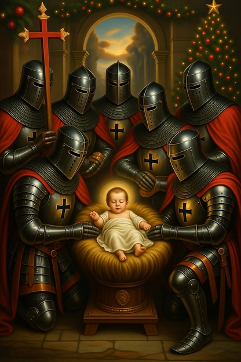
In this season, we as Knights Templar also contemplate a specific manifestation of light entering the world—that moment when, as our Christian tradition teaches, the Divine Light took human form. The Word became flesh.
Our spiritual ancestors chose to celebrate this event at the winter solstice because they recognized the profound connection between the cosmic pattern and spiritual reality. At the darkest moment, light enters. When night has reached its greatest extent, dawn is nearest.
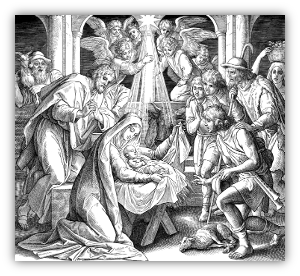
The stable in Bethlehem represents what our degrees have taught: that light often comes in unexpected ways, to unexpected places, through unexpected means. The Greatest Light appears quietly, humbly, accessible to shepherds and wise men alike.
This is light that does not blind or intimidate but draws near. Light that enters into darkness rather than simply dispelling it from afar.
For the Mason who has sought light throughout his journey, this represents the ultimate truth: the Light we search for has searched for us. The Divine Illumination we pursue has pursued us. The Truth we dig through ruins to recover has been working to reveal itself to us all along.
Living in the Return of Light
What does this mean for us practically?
First, we carry the certainty that darkness is not permanent. In our personal struggles, our fraternal challenges, our societal difficulties—the pattern holds. The darkness may be deep, but it has limits. Light will return, as surely as the sun begins its climb after the solstice.
Second, we commit to being light-bearers ourselves. We have received light through our degrees. This light is not for us alone. Like the vault-builders who labored for future generations, we must ensure that what we have received is preserved and transmitted.
Third, we recognize that great light often comes quietly. The return of light at the solstice is almost imperceptible at first—minutes added to each day, barely noticeable. Yet those minutes accumulate. Small illuminations, faithfully received and acted upon, transform over time into full day.
Finally, we maintain hope. Not naive optimism that ignores darkness, but mature hope grounded in pattern and promise. We hope because we have seen light emerge from darkness before. We hope because the structure of reality favors light’s triumph.
The Convergence of Journeys
Brothers, our personal journeys as Masons, our yearly journey through the solar cycle, and the great journey of humanity toward understanding all converge at this moment.
The Royal Arch taught us to search through ruins—we searched, and we found.
The Cryptic degrees taught us to preserve and prepare, to trust that darkness could not permanently prevail.
The Orders of Knighthood called us to embody the light we had received, to defend truth, to serve others.
And now, at the turning of the year, at the return of light from its lowest ebb, we stand as men who have completed these journeys and who bear responsibility for their lessons.
We are the returned exiles who have recovered what was lost. We are the faithful builders who preserve light for the future. We are the knights who defend what is true. We are the companions who have seen light emerge from darkness and who testify to its reality.
Conclusion
As we conclude this observance, feel the truth of this season. Outside, though we cannot see it, the cosmic machinery has shifted. Each day from now until summer will be longer than the last. The light grows—slowly, steadily, surely.
This is our assurance and our commission. The light grows. Our task is to align ourselves with its growth, to participate in its expansion, to become its bearers and defenders.
Let us leave here tonight not as men who have attended a ceremony, but as men renewed in our primary purpose: the search for light and the commitment to share whatever light we find.
Companions and Sir Knights: The darkness was deep, but the light has returned. It returns in the heavens. It returns in our hearts. It returns in our Commanderies, Councils, and Chapters. It returns in the world that so desperately needs it.
The journey from darkness to light is the Mason’s eternal quest. Tonight, we celebrate that this journey is not futile. The light does return. The truth can be recovered. The way forward exists.
May this season of returning light illuminate your path, strengthen your resolve, and renew your commitment to our ancient search. May you always look to Him who stated “I am the light of the world: he that followeth me shall not walk in darkness, but shall have the light of life.” Merry Christmas, and may the light grow ever brighter in the year to come.
In Hoc Signo Vinces – In this sign, we conquer.
Amen!
So mote it be.
The phrase “Remember that you have promised to remind him, in the most tender manner, of his failings and to aid in his reformation as well as to vindicate his character when wrongfully traduced” represents one of the most profound obligations within Freemasonry, encapsulating the essence of what it means to be a true brother in the craft. This sacred duty, woven into the very fabric of Masonic obligation, speaks to a higher calling that transcends mere social fellowship and enters the realm of spiritual responsibility for one’s fellow man.
Within the ancient landmarks of Freemasonry, this principle finds its clearest expression in the concept of brotherly love, relief, and truth—the three great pillars upon which the institution stands. The obligation to correct a brother “in the most tender manner” is not merely a suggestion but a solemn vow taken before the Great Architect of the Universe, binding the Mason to act as both guardian and guide to his brethren.
Albert Pike, in his seminal work “Morals and Dogma,” emphasizes that the Mason must be “ever ready to assist a distressed worthy Master Mason, his widow and orphans,” but this assistance extends beyond material aid to encompass moral and spiritual guidance. The Scottish Rite degrees, particularly the 14th Degree of Perfect Elf, elaborate on this concept by teaching that correction without malice, administered with love and understanding, is among the highest forms of service one can render to another human being.
The ancient charges of Freemasonry, dating back to the medieval stonemasons’ guilds, consistently emphasize the duty of mutual correction and support. The Regius Manuscript of 1390 speaks of masons who must “love well together as sisters and brothers,” implying not just affection but active concern for one another’s moral welfare. This tradition continued through Anderson’s Constitutions of 1723, which explicitly state that Masons should “act as becomes moral and wise men.”
The Eastern religious traditions offer profound insights into the practice of gentle correction that align remarkably with Masonic principles. In Buddhism, the concept of “Right Speech” as part of the Noble Eightfold Path encompasses not only avoiding harmful speech but actively engaging in discourse that promotes the spiritual welfare of others. The Buddha himself, in the Vinaya texts, established elaborate protocols for the correction of monks that emphasize privacy, gentleness, and genuine concern for the individual’s spiritual progress.
The Buddhist notion of “skillful means” (upaya) is particularly relevant here. This principle teaches that the method of correction must be tailored to the individual’s capacity for understanding and their current spiritual state. A harsh rebuke might cause one person to reform, while gentle guidance might be necessary for another. This mirrors the Masonic emphasis on correction delivered “in the most tender manner”—recognizing that the goal is reformation, not humiliation.
In Hinduism, the concept of “satsang”—association with the virtuous—inherently includes the duty of mutual correction and elevation. The Bhagavad Gita speaks of the wise person who, like a friend, shows others their faults not out of malice but out of love. Krishna’s correction of Arjuna throughout the great dialogue exemplifies this principle: firm in moral truth yet delivered with infinite compassion and understanding.
The Jain tradition, with its emphasis on ahimsa (non-violence), extends this principle to include violence of speech and thought. The practice of correcting others must be undertaken with such care that no unnecessary pain is inflicted, and the primary motivation must always be the spiritual benefit of the one being corrected. This aligns perfectly with the Masonic obligation to aid in a brother’s reformation while preserving his dignity.
The Judeo-Christian tradition provides perhaps the most direct parallels to this Masonic obligation. Christ’s teaching in Matthew 18:15-17 establishes a clear protocol for fraternal correction: “If your brother sins against you, go and tell him his fault, between you and him alone. If he listens to you, you have gained your brother.” This passage emphasizes privacy, gentleness, and the ultimate goal of reconciliation—principles that directly mirror the Masonic approach.
Saint Paul’s letters are replete with instructions on the proper manner of correction within the Christian community. In Galatians 6:1, he writes, “Brothers, if anyone is caught in any transgression, you who are spiritual should restore him in a spirit of gentleness. Keep watch on yourself, lest you too be tempted.” This warning against self-righteousness is crucial to understanding the Masonic obligation—the corrector must approach his task with humility and self-awareness.
The monastic traditions of Christianity developed sophisticated approaches to fraternal correction that bear striking similarities to Masonic practice. The Rule of Saint Benedict, written in the 6th century, establishes procedures for correction that emphasize privacy, graduated responses, and always the hope of reformation. The abbot is instructed to “hate the faults but love the brothers,” a sentiment that perfectly captures the spirit of the Masonic obligation.
Thomas Aquinas, in his Summa Theologiae, addresses the duty of fraternal correction as an act of charity—not optional kindness, but obligatory love. He argues that just as we would save a brother from physical danger, so must we act to save him from moral peril. However, Aquinas emphasizes that this correction must be undertaken with prudence, considering the likelihood of success and the potential for causing greater harm through inappropriate intervention.
The philosophical implications of this Masonic obligation touch upon fundamental questions of moral responsibility and the nature of human relationships. Aristotle’s concept of friendship in the Nicomachean Ethics provides crucial insight here. He distinguishes between friendships of utility, pleasure, and virtue, arguing that only the latter involves genuine concern for the friend’s moral character. True friendship, according to Aristotle, requires the courage to speak difficult truths in love.
Immanuel Kant’s categorical imperative offers another lens through which to examine this obligation. If we universalize the maxim of gentle fraternal correction, we arrive at a world where all individuals take responsibility for the moral development of their fellows—a world that seems far preferable to one where moral indifference reigns. Kant’s emphasis on treating persons as ends in themselves, never merely as means, requires that correction be undertaken for the benefit of the corrected, not for the satisfaction of the corrector.
The Stoic philosophers, particularly Epictetus and Marcus Aurelius, emphasized the interconnectedness of human beings and the responsibility this creates for mutual care. Marcus Aurelius writes in his Meditations, “We were born to work together like feet, hands, and eyes, like the two rows of teeth, upper and lower.” This organic view of human society suggests that correction of others is not interference but necessary maintenance of the social body.
John Stuart Mill’s harm principle, articulated in “On Liberty,” might initially seem to argue against unsolicited moral intervention. However, Mill himself recognized that the boundaries between self-regarding and other-regarding actions are often unclear, and that genuine friendship creates special obligations that transcend general principles of non-interference.
The second part of the Masonic obligation—”to vindicate his character when wrongfully traduced”—represents the complementary duty of defense. This obligation recognizes that in a world where reputation can be destroyed by rumor and slander, the brotherhood must serve as a bulwark protecting the innocent from false accusation.
This principle finds expression in the Jewish concept of “lashon hara” (evil speech), which forbids not only speaking ill of others but also listening to such speech when it serves no constructive purpose. The obligation to defend a brother’s character requires active resistance to gossip and calumny, positioning the Mason as a guardian of truth in a world often dominated by prejudice and false witness.
The Islamic tradition’s emphasis on “husn al-zann” (good opinion) requires believers to assume the best of others unless proven otherwise. This principle, when combined with the duty to defend the innocent, creates a powerful framework for protecting reputation and character. The Quran explicitly states that those who “launch a charge against chaste women” without proper evidence are to be rejected as witnesses, emphasizing the serious nature of character assassination.
From a philosophical standpoint, this obligation to vindicate character reflects a deep understanding of human dignity and the social nature of identity. Charles Taylor’s work on recognition suggests that our sense of self is fundamentally shaped by how others see us. Therefore, the duty to protect a brother’s reputation is really a duty to protect his very identity and capacity for moral agency.
The specification that correction must be delivered “in the most tender manner” reveals a sophisticated understanding of human psychology and moral development. This requirement recognizes that the method of correction is as important as the correction itself—that a truth delivered harshly may be rejected, while the same truth offered with love may transform a life.
The ancient Greek concept of “parrhesia”—fearless speech or speaking truth to power—evolved throughout classical antiquity to emphasize not just courage in speaking truth, but wisdom in how that truth is communicated. Plutarch, in his essay “How to Tell a Flatterer from a Friend,” argues that true friends must have the courage to speak painful truths, but must do so with such evident love and concern that the bitter medicine of correction is made palatable.
Buddhist meditation practices offer practical techniques for developing the mental states necessary for tender correction. The cultivation of loving-kindness (metta) and compassion (karuna) prepares the mind to approach others’ faults without anger or superiority. The practice of mindfulness ensures that correction arises from wisdom rather than emotional reactivity.
The Christian mystic tradition speaks of the “spiritual direction” relationship, where a more experienced practitioner guides another in their spiritual development. The great masters of this tradition—from John of the Cross to Teresa of Avila—emphasize that effective guidance requires not only knowledge but love, patience, and the ability to meet each soul where they are in their journey.
In our contemporary world, marked by increasing polarization and the decline of traditional community structures, the Masonic obligation to gentle correction and character defense takes on renewed urgency. Social media and digital communication have created new possibilities for both constructive guidance and destructive gossip, making the Mason’s role as guardian of truth and protector of reputation more crucial than ever.
The psychological research on effective behavior change supports the wisdom embedded in this ancient obligation. Studies consistently show that correction delivered with empathy and respect is more likely to be accepted and acted upon than correction delivered with hostility or condescension. The work of psychologists like Carl Rogers on unconditional positive regard demonstrates that people are most open to change when they feel truly accepted and valued.
The concept of “restorative justice,” increasingly adopted in criminal justice systems worldwide, reflects principles that align closely with the Masonic approach to correction. Rather than focusing purely on punishment, restorative justice seeks to heal relationships and restore community harmony—goals that mirror the Mason’s obligation to aid in reformation while maintaining brotherly bonds.
While this obligation is specific to Masonic brothers, its principles have universal application. The recognition that all human beings are works in progress, deserving of both guidance and protection, forms the foundation of a more compassionate society. The Mason who practices these principles within the lodge becomes an agent of positive change in the broader community.
The philosopher Emmanuel Levinas spoke of the infinite responsibility we bear for the “Other”—a responsibility that includes both the duty to guide and the duty to protect. This responsibility is not based on contracts or agreements but on the fundamental recognition of shared humanity. The Masonic obligation formalizes this universal human duty within the specific context of fraternal relationship.
Martin Buber’s distinction between “I-Thou” and “I-It” relationships provides another framework for understanding this obligation. Genuine correction can only occur within an I-Thou relationship, where the corrector recognizes the full personhood and dignity of the one being corrected. This requires moving beyond mere rule-following to authentic encounter and care.
The Masonic obligation to remind a brother of his failings in the most tender manner and to vindicate his character when wrongfully accused represents far more than a simple rule of conduct. It embodies a vision of human relationship that acknowledges both our mutual responsibility for one another’s moral development and our capacity for transformation through love.
This obligation challenges the modern individualistic assumption that we bear no responsibility for others’ choices or character. Instead, it asserts that true brotherhood—whether Masonic or universal—requires the courage to speak difficult truths and the commitment to defend the innocent. It recognizes that human beings are not isolated monads but interconnected souls whose wellbeing is intimately linked.
The wisdom embedded in this simple phrase draws upon the deepest insights of human civilization, from the Buddha’s teachings on right speech to Christ’s instructions on fraternal correction, from Aristotle’s analysis of friendship to Kant’s categorical imperative. It represents a convergence of religious and philosophical traditions around the fundamental truth that love sometimes requires difficult conversations and always requires faithful defense.
For the modern Mason, this obligation serves as a daily reminder that the principles learned in the lodge must be lived in the world. It calls us to be neither harsh judges nor silent enablers, but wise counselors and faithful defenders of truth and character. In a world increasingly marked by moral relativism and social fragmentation, the Mason who honors this obligation becomes a beacon of stability and hope—a reminder that human beings can indeed be their brothers’ keepers without becoming their brothers’ tyrants.
The transformative power of this obligation lies not merely in its effect on those who receive correction or defense, but on those who give it. The practice of gentle correction cultivates humility, wisdom, and compassion. The commitment to defend character develops courage, justice, and loyalty. Together, they form the Mason into the kind of person who makes the world a better place simply by being in it.
In the end, this ancient Masonic obligation points toward a vision of human community that transcends the boundaries of lodge or nation—a community where truth is spoken in love, where character is protected from false attack, and where each person takes responsibility for the moral wellbeing of all. It is a vision worthy of the Great Architect of the Universe and achievable by those who commit themselves to its practice with sincerity and dedication.
The phrase thus stands not merely as an obligation but as an invitation—an invitation to participate in the sacred work of human transformation and to contribute to the building of that more perfect union of souls that is the ultimate aim of all genuine spiritual endeavor. In remembering this promise, the Mason remembers not just a rule but a calling, not just a duty but a privilege, not just an obligation but an opportunity to serve the highest and best in human nature.